
Transformers documentation
ViTMAE
该模型于 2021-11-11 在 HF papers 上发布,并于 2022-01-18 贡献给 Hugging Face Transformers。


ViTMAE
ViTMAE 是一种自监督视觉模型,通过遮蔽图像的大部分区域(约 75%)进行预训练。编码器处理可见的图像块,解码器则根据编码后的图像块和掩码标记重建缺失的像素。预训练完成后,编码器可复用于图像分类或目标检测等下游任务——其性能通常优于使用监督学习训练的模型。
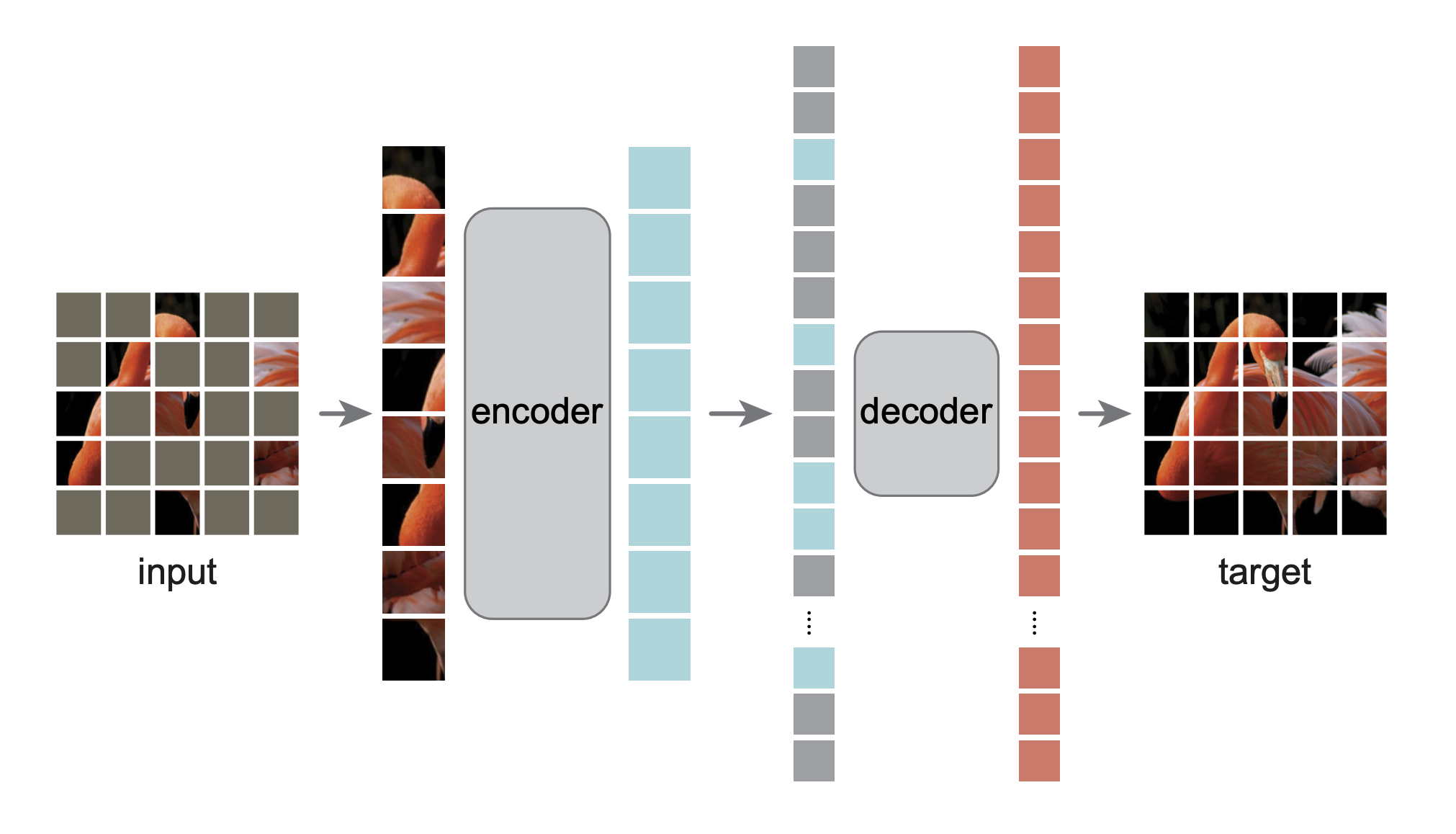
您可以在 AI at Meta 组织下找到所有原始的 ViTMAE 检查点。
点击右侧边栏中的 ViTMAE 模型,以查看更多将 ViTMAE 应用于视觉任务的示例。
以下示例演示了如何使用 ViTMAEForPreTraining 类重建缺失的像素。
import requests
import torch
from PIL import Image

from transformers import ViTImageProcessor, ViTMAEForPreTraining


url = "https://huggingface.co/datasets/huggingface/documentation-images/resolve/main/pipeline-cat-chonk.jpeg"
image = Image.open(requests.get(url, stream=True).raw)

processor = ViTImageProcessor.from_pretrained("facebook/vit-mae-base")
inputs = processor(image, return_tensors="pt").to(model.device)
inputs = {k: v.to(model.device) for k, v in inputs.items()}

model = ViTMAEForPreTraining.from_pretrained("facebook/vit-mae-base", attn_implementation="sdpa", device_map="auto")
with torch.no_grad():
    outputs = model(**inputs)

reconstruction = outputs.logits
备注
- ViTMAE 通常分两个阶段使用。首先使用 ViTMAEForPreTraining 进行自监督预训练,然后丢弃解码器并对编码器进行微调。微调完成后,可以将权重加载到 ViTForImageClassification 等模型中。
- 使用 ViTImageProcessor 进行输入准备。
资源
- 请参考此 notebook,了解如何可视化 ViTMAEForPreTraining 重建的像素。
ViTMAEConfig
class transformers.ViTMAEConfig
< source >( transformers_version: str | None = Nonearchitectures: list[str] | None = Noneoutput_hidden_states: bool | None = Falsereturn_dict: bool | None = Truedtype: str | torch.dtype | None = Nonechunk_size_feed_forward: int = 0is_encoder_decoder: bool = Falseid2label: dict[int, str] | dict[str, str] | None = Nonelabel2id: dict[str, int] | dict[str, str] | None = Noneproblem_type: Literal['regression', 'single_label_classification', 'multi_label_classification'] | None = Nonehidden_size: int = 768num_hidden_layers: int = 12num_attention_heads: int = 12intermediate_size: int = 3072hidden_act: str = 'gelu'hidden_dropout_prob: float | int = 0.0attention_probs_dropout_prob: float | int = 0.0initializer_range: float = 0.02layer_norm_eps: float = 1e-12image_size: int | list[int] | tuple[int, int] = 224patch_size: int | list[int] | tuple[int, int] = 16num_channels: int = 3qkv_bias: bool = Truedecoder_num_attention_heads: int = 16decoder_hidden_size: int = 512decoder_num_hidden_layers: int = 8decoder_intermediate_size: int = 2048mask_ratio: float = 0.75norm_pix_loss: bool = False )
参数
- hidden_size (
int,可选,默认为768) — 隐藏表示的维度。 - num_hidden_layers (
int, 可选, 默认为12) — Transformer 解码器中的隐藏层数量。 - num_attention_heads (
int,可选,默认为12) — Transformer 解码器中每个注意力层的注意力头数量。 - intermediate_size (
int,可选,默认为3072) — MLP 表示的维度。 - hidden_act (
str,可选,默认为gelu) — 解码器中的非线性激活函数(函数或字符串)。例如,"gelu"、"relu"、"silu"等。 - hidden_dropout_prob (
Union[float, int],可选,默认为0.0) — 嵌入层、编码器和池化层中所有全连接层的 dropout 概率。 - attention_probs_dropout_prob (
Union[float, int],可选,默认为0.0) — 注意力概率的 dropout 比率。 - initializer_range (
float,可选,默认为0.02) — 用于初始化所有权重矩阵的 truncated_normal_initializer 的标准差。 - layer_norm_eps (
float,可选,默认为1e-12) — 层归一化层所使用的 epsilon 值。 - image_size (
Union[int, list[int], tuple[int, int]],可选,默认为224) — 每张图片的尺寸(分辨率)。 - patch_size (
Union[int, list[int], tuple[int, int]],可选,默认为16) — 每个 patch 的大小(分辨率)。 - num_channels (
int,可选,默认为3) — 输入通道的数量。 - qkv_bias (
bool,可选,默认为True) — 是否向查询、键和值添加偏置。 - decoder_num_attention_heads (
int,可选,默认值为16) — Transformer 解码器中每个注意力层的注意力头数量。 - decoder_hidden_size (
int,可选,默认为512) — 隐藏表示的维度。 - decoder_num_hidden_layers (
int,可选,默认为 8) — 解码器中的隐藏层数量。 - decoder_intermediate_size (
int,可选,默认为2048) — MLP 表示的维度。 - mask_ratio (
float,可选,默认值为 0.75) — 输入序列中被掩码标记的数量比例。 - norm_pix_loss(
bool,可选,默认为False)— 是否使用归一化像素进行训练(参见论文中的表 3)。在作者的实验中,使用归一化像素提升了表征质量。
这是用于存储 ViTMAEModel 配置的类。它根据指定的参数实例化 Vit Mae 模型,并定义模型架构。使用默认值实例化配置将得到与 facebook/vit-mae-base 类似的配置。
配置对象继承自 PreTrainedConfig,可用于控制模型输出。有关更多信息,请参阅 PreTrainedConfig 的文档。
示例:
>>> from transformers import ViTMAEConfig, ViTMAEModel

>>> # Initializing a ViT MAE vit-mae-base style configuration
>>> configuration = ViTMAEConfig()

>>> # Initializing a model (with random weights) from the vit-mae-base style configuration
>>> model = ViTMAEModel(configuration)

>>> # Accessing the model configuration
>>> configuration = model.config
ViTMAEModel
class transformers.ViTMAEModel
< source >( config: ViTMAEConfig )
参数
- config (ViTMAEConfig) — 模型的配置。
未添加任何特定头部的裸 Vit Mae 模型,直接输出原始隐藏状态。
该模型继承自 PreTrainedModel。请查阅父类文档,了解该库为所有模型实现的通用方法(例如下载或保存、调整输入嵌入大小、剪枝头等)。
该模型也是 PyTorch torch.nn.Module 的子类。 请将其作为常规的 PyTorch Module 使用,有关通用用法和行为的所有事项,请参阅 PyTorch 文档。
forward
< source >( pixel_values: typing.Optional[torch.Tensor] = Nonenoise: typing.Optional[torch.Tensor] = Noneinterpolate_pos_encoding: bool | None = Noneattention_mask: typing.Optional[torch.Tensor] = None**kwargs: *<class 'transformers.utils.generic.TransformersKwargs'> ) → ViTMAEModelOutput or tuple(torch.Tensor)
参数
- pixel_values (
torch.Tensor,形状为(batch_size, num_channels, image_size, image_size),可选) — 与输入图像对应的张量。可以使用 ViTImageProcessor 获取像素值。有关详细信息,请参阅 ViTImageProcessor.call()(processor_class使用 ViTImageProcessor 处理图像)。 - noise (
torch.Tensor,形状为(batch_size, sequence_length),可选) — 主要用于测试目的,以控制随机性并保持可复现性 - interpolate_pos_encoding (
bool,可选,默认值为False) — 是否对预训练的位置编码进行插值。这主要用于在更高分辨率的图像上使用模型。 - attention_mask (
torch.Tensor形状为(batch_size, sequence_length), ,可选) — 用于避免对填充 token 索引执行注意力机制的掩码。掩码值取自[0, 1]:- 1 表示未被屏蔽的 token,
- 对于被掩码的 token,值为 0。
返回值
ViTMAEModelOutput 或 tuple(torch.Tensor)
ViTMAEModelOutput 或 torch.Tensor 元组(当传入 return_dict=False 或 config.return_dict=False 时),其包含的元素取决于配置(ViTMAEConfig)和输入。
ViTMAEModel 的 forward 方法重写了 __call__ 特殊方法。
尽管前向传播的实现需要在此函数中定义,但之后应调用
Module实例,而不是直接调用此函数,因为前者会负责执行预处理和后处理步骤,而后者则会静默地忽略这些步骤。
last_hidden_state(形状为
(batch_size, sequence_length, hidden_size)的torch.Tensor,可选)— 模型最后一层输出的隐藏状态序列。mask(形状为
(batch_size, sequence_length)的torch.Tensor)— 指示哪些 patch 被掩码(1)、哪些未被掩码(0)的张量。ids_restore(形状为
(batch_size, sequence_length)的torch.LongTensor)— 包含(打乱后的)掩码补丁原始索引的张量。hidden_states (
tuple[torch.Tensor],可选,当传入output_hidden_states=True或config.output_hidden_states=True时返回) — 一个torch.Tensor元组(如果模型具有嵌入层,则包含嵌入层输出的一个张量,以及每个层输出的一个张量),形状为(batch_size, sequence_length, hidden_size)。模型在每一层输出处的隐藏状态,以及可选的初始嵌入输出。
attentions (
tuple[torch.Tensor],可选,当传入output_attentions=True或config.output_attentions=True时返回) — 一个torch.Tensor元组(每层一个),形状为(batch_size, num_heads, sequence_length, sequence_length)。注意力权重,即经过注意力 softmax 之后的权重,用于在自注意力头中计算加权平均值。
示例:
>>> from transformers import AutoImageProcessor, ViTMAEModel
>>> from PIL import Image
>>> from huggingface_hub.utils import httpx
>>> from io import BytesIO

>>> url = "http://images.cocodataset.org/val2017/000000039769.jpg"
>>> with httpx.stream("GET", url) as response:
...     image = Image.open(BytesIO(response.read()))

>>> image_processor = AutoImageProcessor.from_pretrained("facebook/vit-mae-base")
>>> model = ViTMAEModel.from_pretrained("facebook/vit-mae-base")

>>> inputs = image_processor(images=image, return_tensors="pt")
>>> outputs = model(**inputs)
>>> last_hidden_states = outputs.last_hidden_state
ViTMAEForPreTraining
class transformers.ViTMAEForPreTraining
< source >( config: ViTMAEConfig )
参数
- config (ViTMAEConfig) — 模型的配置类,包含模型的所有参数。使用配置文件进行初始化时,不会加载与模型关联的权重,仅加载配置。请查看 from_pretrained() 方法以加载模型权重。
带有解码器的 ViTMAE 模型 Transformer,用于自监督预训练。
该模型继承自 PreTrainedModel。请查阅父类文档,了解该库为所有模型实现的通用方法(例如下载或保存、调整输入嵌入大小、剪枝头等)。
该模型也是 PyTorch torch.nn.Module 的子类。 请将其作为常规的 PyTorch Module 使用,有关通用用法和行为的所有事项,请参阅 PyTorch 文档。
forward
< source >( pixel_values: typing.Optional[torch.Tensor] = Nonenoise: typing.Optional[torch.Tensor] = Noneinterpolate_pos_encoding: bool | None = Noneattention_mask: typing.Optional[torch.Tensor] = None**kwargs: *<class 'transformers.utils.generic.TransformersKwargs'> ) → ViTMAEForPreTrainingOutput or tuple(torch.Tensor)
参数
- pixel_values (
torch.Tensor,形状为(batch_size, num_channels, image_size, image_size),可选) — 与输入图像对应的张量。可以使用 ViTImageProcessor 获取像素值。有关详细信息,请参阅 ViTImageProcessor.call()(processor_class使用 ViTImageProcessor 处理图像)。 - noise (
torch.Tensor,形状为(batch_size, sequence_length),可选) — 主要用于测试目的,以控制随机性并保持可复现性 - interpolate_pos_encoding (
bool,可选,默认值为False) — 是否对预训练的位置编码进行插值。这主要用于在更高分辨率的图像上使用模型。 - attention_mask (
torch.Tensor形状为(batch_size, sequence_length), ,可选) — 用于避免对填充 token 索引执行注意力机制的掩码。掩码值取自[0, 1]:- 1 表示未被屏蔽的 token,
- 对于被掩码的 token,值为 0。
返回值
ViTMAEForPreTrainingOutput 或 tuple(torch.Tensor)
ViTMAEForPreTrainingOutput 或 torch.Tensor 元组(如果传入 return_dict=False 或 config.return_dict=False),包含根据配置(ViTMAEConfig)和输入而定的各种元素。
ViTMAEForPreTraining 的 forward 方法重写了 __call__ 特殊方法。
尽管前向传播的实现需要在此函数中定义,但之后应调用
Module实例,而不是直接调用此函数,因为前者会负责执行预处理和后处理步骤,而后者则会静默地忽略这些步骤。
loss(形状为
(1,)的torch.Tensor)— 像素重建损失。logits(形状为
(batch_size, sequence_length, patch_size ** 2 * num_channels)的torch.Tensor)— 像素重建 logits。mask(形状为
(batch_size, sequence_length)的torch.Tensor)— 指示哪些 patch 被掩码(1)、哪些未被掩码(0)的张量。ids_restore(形状为
(batch_size, sequence_length)的torch.LongTensor)— 包含(打乱后的)掩码补丁原始索引的张量。hidden_states (
tuple[torch.Tensor],可选,当传入output_hidden_states=True或config.output_hidden_states=True时返回) — 一个torch.Tensor元组(如果模型具有嵌入层,则包含嵌入层输出的一个张量,以及每个层输出的一个张量),形状为(batch_size, sequence_length, hidden_size)。模型在每一层输出处的隐藏状态,以及可选的初始嵌入输出。
attentions (
tuple[torch.Tensor],可选,当传入output_attentions=True或config.output_attentions=True时返回) — 一个torch.Tensor元组(每层一个),形状为(batch_size, num_heads, sequence_length, sequence_length)。注意力权重,即经过注意力 softmax 之后的权重,用于在自注意力头中计算加权平均值。
示例:
>>> from transformers import AutoImageProcessor, ViTMAEForPreTraining
>>> from PIL import Image
>>> from huggingface_hub.utils import httpx
>>> from io import BytesIO

>>> url = "http://images.cocodataset.org/val2017/000000039769.jpg"
>>> with httpx.stream("GET", url) as response:
...     image = Image.open(BytesIO(response.read())).convert("RGB")

>>> image_processor = AutoImageProcessor.from_pretrained("facebook/vit-mae-base")
>>> model = ViTMAEForPreTraining.from_pretrained("facebook/vit-mae-base")

>>> inputs = image_processor(images=image, return_tensors="pt")
>>> outputs = model(**inputs)
>>> loss = outputs.loss
>>> mask = outputs.mask
>>> ids_restore = outputs.ids_restore