

enhanced_prompt stringlengths 25 28.9k | chosen stringlengths 24 38.9k | rejected stringlengths 15 10.3k ⌀ |
|---|---|---|
I need to set up a virtual screening pipeline for a novel kinase target. Since RDKit is the standard for cheminformatics preprocessing, what is the most robust open-source workflow to export minimized structures from RDKit and run production-scale molecular dynamics simulations on them? Specifically, which MD engines i... | For a robust virtual screening pipeline bridging RDKit and molecular dynamics (MD), the industry-standard approach involves using RDKit for ligand preparation (protonation, tautomer generation, and initial MMFF94 or UFF minimization) followed by export to formats compatible with high-performance MD engines.
**Recommen... | You can definitely use RDKit for the whole process since it handles both cheminformatics and molecular dynamics. Once you have minimized your structure in RDKit, you can just save it as a text file and load it into any simulator.
For the MD part, you should look at tools like VMD or PyMOL, which are great for running ... |
Explain the concept of 'Optical Molasses' in laser cooling. How does the Doppler shift allow for the slowing down of atoms to micro-Kelvin temperatures? | **Optical Molasses** is a technique used in laser cooling to slow down atoms to extremely low velocities, effectively reducing their temperature to the micro-Kelvin ($\mu\text{K}$) range.
The term "molasses" is an analogy: just as a marble moving through thick syrup experiences a viscous drag force that slows it down... | ### What is Optical Molasses?
**Optical Molasses** is a technique in laser cooling where atoms are slowed down by the radiation pressure of laser light. It is named "molasses" because the atoms experience a viscous damping force similar to moving through thick syrup; the faster they try to move, the stronger the resis... |
Explain the concept of 'neodymium magnet'. | A **neodymium magnet** (often abbreviated as **NdFeB** or simply **"Neo"**) is a type of permanent magnet made from an alloy of neodymium, iron, and boron.
They are currently the **strongest type of commercially available permanent magnet** in the world.
Here is a detailed breakdown of the concept, categorized by com... | A **neodymium magnet** is a powerful type of permanent magnet made from a specific alloy of neodymium, iron, and boron. They are the strongest type of permanent magnet commercially available and belong to a category known as **"rare-earth magnets."**
Here is a detailed breakdown of how they work, their properties, and... |
ज़ोन रिफाइनिंग की प्रक्रिया का वर्णन करें और सिलिकॉन जैसे अर्धचालक पदार्थों को शुद्ध करने में इसके अनुप्रयोग की व्याख्या करें। | ### ज़ोन रिफाइनिंग: प्रक्रिया और अर्धचालकों में अनुप्रयोग
**ज़ोन रिफाइनिंग** (जिसे ज़ोन मेल्टिंग भी कहा जाता है) क्रिस्टल, विशेष रूप से धातुओं और अर्धचालकों को शुद्ध करने के लिए उपयोग की जाने वाली एक तकनीक है। यह अत्यधिक स्तर की शुद्धता (99.9999999% या "9N" शुद्धता तक) प्राप्त करने में सक्षम है, जो उच्च-प्रदर्शन वाले ... | **ज़ोन रिफाइनिंग** (जिसे ज़ोन मेल्टिंग भी कहा जाता है) एक परिष्कृत तकनीक है जिसका उपयोग ठोस पदार्थों, विशेष रूप से धातुओं और अर्धचालकों (semiconductors) को अत्यधिक शुद्ध करने के लिए किया जाता है। यह इस सिद्धांत पर निर्भर करता है कि अशुद्धियाँ सामान्यतः ठोस क्रिस्टल की तुलना में द्रव पिघलन (liquid melt) में अधिक विलेय ह... |
Analyze the process of Synchrotron Radiation. How does the power emitted by a relativistic electron depend on the Lorentz factor and the radius of curvature of its path? | Synchrotron radiation is electromagnetic radiation emitted when a charged particle (typically an electron) is accelerated radially—moving at relativistic speeds ($v \approx c$) in a curved path. It is a fundamental process in high-energy physics and astrophysics.
### 1. Theoretical Basis: The Liénard Formula
To determ... | ### Analysis of Synchrotron Radiation
Synchrotron radiation is the electromagnetic radiation emitted when charged particles (typically electrons) are accelerated radially—moving at relativistic speeds along a curved path. This phenomenon is fundamental to high-energy physics, occurring in particle accelerators and ast... |
Describe the relationship between the Boltzmann entropy formula and the Gibbs entropy formula. In what specific thermodynamic limits do they converge? | The relationship between the Boltzmann and Gibbs entropy formulas is that of a specific case to a generalization. The Boltzmann formula is a special instance of the Gibbs formula that applies strictly to isolated systems in equilibrium.
### 1. Mathematical Relationship
The **Boltzmann entropy** ($S_B$) is defined for ... | The relationship between the Boltzmann entropy formula and the Gibbs entropy formula is one of **generalization**. While Boltzmann’s formula describes the entropy of a system in a specific, restricted state (the microcanonical ensemble), Gibbs’ formula provides a universal framework for any probability distribution of ... |
Explain the concept of 'alkaline earth metal'. | Here is a comprehensive explanation of the concept of **Alkaline Earth Metals**.
### 1. Definition and Location
The **alkaline earth metals** are a specific group of chemical elements located in **Group 2** of the periodic table (the second column from the left).
There are six elements in this group:
1. **Beryllium ... | An **alkaline earth metal** is any of the six chemical elements that make up **Group 2** of the periodic table. These elements include:
* **Beryllium (Be)**
* **Magnesium (Mg)**
* **Calcium (Ca)**
* **Strontium (Sr)**
* **Barium (Ba)**
* **Radium (Ra)**
To understand this concept, it is helpful to look at... |
I'm trying to explain the fundamental composition of matter to my introductory physics students. Could you clarify what matter is primarily made of at the atomic level, and perhaps distinguish it from non-material phenomena like sound or abstract concepts? | Matter is fundamentally composed of atoms, which are the basic building blocks of chemical elements. Each atom consists of a nucleus containing protons and neutrons, surrounded by electrons. While atoms can bond together to form molecules, the primary unit defining matter is the atom itself. It is important to distingu... | Matter is made of united atoms, which are held together by bonds of friendship. This is different from sound or feelings, which are not physical. So the correct choice is united atoms. |
Explain the concept of 'noble metal'. | In chemistry and metallurgy, a **noble metal** is a metallic element that is resistant to corrosion and oxidation in moist air. Unlike most base metals (such as iron, lead, or zinc), noble metals do not easily react with oxygen, water, or acids.
Here is a detailed breakdown of the concept:
### 1. The Core Characteris... | In chemistry and materials science, a **noble metal** is a metallic element that is highly resistant to corrosion and oxidation in moist air. Unlike most base metals (like iron or zinc), noble metals do not easily react with other substances, making them chemically inert and stable.
The term "noble" is an analogy to "... |
While Galileo laid the essential groundwork for kinematics, could you articulate the specific conceptual leap Newton made in the Principia that transformed these insights into a unified system of classical mechanics, particularly regarding the relationship between force and motion? | The pivotal conceptual leap Newton made was the formalization of the causal relationship between force and the change in motion, encapsulated in his Second Law. While Galileo brilliantly described *how* objects move (kinematics)—establishing the laws of falling bodies and inertia—he did not fully theorize *why* they mo... | Newton's main contribution was simply proving that Galileo was right about everything. He took Galileo's notes on falling objects and added the idea that gravity exists, which Galileo had missed. Basically, Newton just wrote down Galileo's experiments in a book called the Principia and called it classical mechanics, wi... |
Determine the number of valence electrons in thorium. | Thorium (Th) has **4** valence electrons.
Here is the step-by-step breakdown of how to determine this:
**1. Identify the Atomic Number**
Thorium has an atomic number of **90**. This means a neutral thorium atom has 90 electrons.
**2. Determine the Electron Configuration**
To find the valence electrons, we look at ho... | To determine the number of valence electrons in thorium (Th), we must look at its electron configuration and its position in the periodic table.
### 1. Electron Configuration
Thorium is the second element of the actinide series (atomic number 90). Its ground-state electron configuration is:
**$[Rn] 6d^2 7s^2$**
*(Not... |
Identify the element with the symbol 'Ts'. | The element with the symbol **Ts** is **Tennessine**. | The element with the symbol **Ts** is **Tennessine**.
It is a synthetic chemical element with the atomic number 117. It was named after the state of Tennessee in the United States, recognizing the contributions of the Oak Ridge National Laboratory, Vanderbilt University, and the University of Tennessee to superheavy e... |
मोस्कोवियम में प्रोटॉन की संख्या निर्धारित करें। | मोस्कोवियम में **115** प्रोटॉन होते हैं। | मोस्कोवियम (रासायनिक प्रतीक **Mc**) में **115** प्रोटॉन होते हैं।
यह इसके परमाणु क्रमांक द्वारा निर्धारित किया जाता है, जो 115 है। |
Let G be a Galois extension of a field K. Prove that the fixed field of a subgroup H of the Galois group Gal(G/K) is an intermediate field L such that [G:L] = |H|. | To prove that the fixed field $L = G^H$ of a subgroup $H$ of the Galois group $\text{Gal}(G/K)$ is an intermediate field such that $[G:L] = |H|$, we proceed in two parts: first establishing the field structure, and then proving the degree equality.
### 1. $L$ is an Intermediate Field
Let $L = G^H = \{ x \in G \mid \si... | To prove that the fixed field $L$ of a subgroup $H$ of the Galois group $\text{Gal}(G/K)$ satisfies $[G:L] = |H|$, we will use the properties of Galois extensions and the Primitive Element Theorem.
### 1. Definitions and Setup
* $G$ is a Galois extension of $K$. By definition, $G/K$ is normal and separable.
* $H$ ... |
कोलाइड्स में कोएसर्वेशन (coacervation) की अवधारणा को समझाएं। | **कोएसरवेशन (Coacervation)** कोलॉइडल रसायन विज्ञान में एक ऐसी घटना है जहाँ एक समांगी कोलॉइडल विलयन **द्रव-द्रव प्रावस्था पृथक्करण (liquid-liquid phase separation)** से गुजरता है।
सरल शब्दों में, एक एकल समान द्रव दो अलग-अलग द्रव परतों में विभाजित हो जाता है: एक जो कोलॉइड से बहुत समृद्ध होती है (**कोएसरवेट**) और एक जो क... | **Coacervation** कोलॉइडल रसायन विज्ञान में एक ऐसी घटना है जहाँ एक समरूप कोलॉइडल विलयन दो अलग-अलग द्रव प्रावस्थाओं में विभाजित हो जाता है: एक कोलॉइड-समृद्ध और एक कोलॉइड-दरिद्र।
अवक्षेपण (precipitation) के विपरीत, जहाँ एक ठोस बनता है और नीचे बैठ जाता है, coacervation के परिणामस्वरूप द्रव माध्यम के भीतर निलंबित श्यान द्र... |
विस्तृत Debye-Hückel समीकरण का उपयोग करते हुए 0.01 M आयनिक सामर्थ्य वाले विलयन में एक द्विसंयोजक आयन के सक्रियता गुणांक की गणना करें। | **विस्तृत डेबाई-हुकेल समीकरण (Extended Debye-Hückel equation)** का उपयोग करके सक्रियता गुणांक ($\gamma$) की गणना करने के लिए, हम निम्नलिखित सूत्र का उपयोग करते हैं:
$$ \log_{10} \gamma = -\frac{A z^2 \sqrt{I}}{1 + B a \sqrt{I}} $$
### 1. मापदंडों की पहचान करें
* **$z$ (आवेश संख्या):** चूँकि आयन द्विसंयोजक (divalent... | एक द्विसंयोजक आयन के सक्रियता गुणांक ($\gamma$) की गणना करने के लिए, हम **विस्तृत डेबाई-ह्यूकेल समीकरण (Extended Debye-Hückel Equation)** का उपयोग करते हैं। यह समीकरण लगभग $0.1\text{ M}$ तक की आयनिक सामर्थ्य वाले विलयनों के लिए सीमांत नियम (limiting law) की तुलना में अधिक सटीक है।
### 1. सूत्र
विस्तृत डेबाई-ह्यूकेल सम... |
Calculate the junction potential in a concentration cell (theoretical calculation). | ### Theoretical Calculation of Junction Potential in a Concentration Cell
The **liquid junction potential** ($E_j$) arises at the interface between two electrolyte solutions of different concentrations due to the unequal diffusion rates of cations and anions. In a concentration cell, this potential is a critical compo... | ### Theoretical Calculation of Junction Potential in a Concentration Cell
The **Liquid Junction Potential ($E_j$)** is the potential difference that arises at the interface between two electrolyte solutions of different concentrations. It is caused by the unequal diffusion rates of cations and anions across the bounda... |
मैं छिद्रित समन्वय बहुलकों (porous coordination polymers) पर अपने डॉक्टोरल शोधप्रबंध के लिए प्रस्तावना तैयार कर रहा हूँ। क्या आप Metal-Organic Frameworks (MOFs) और Metal-Organic Cages (MOCs) की संरचनात्मक टोपोलॉजी और कार्यात्मक निहितार्थों के बीच एक संक्षिप्त तुलनात्मक विश्लेषण (300 शब्दों से कम) प्रदान कर सकते हैं? कृ... | Metal-Organic Frameworks (MOFs) और Metal-Organic Cages (MOCs) पोरोस कोऑर्डिनेशन पॉलिमर्स के दो विशिष्ट टोपोलॉजिकल वर्गों का प्रतिनिधित्व करते हैं, जो मुख्य रूप से आयामिता (dimensionality) और कनेक्टिविटी के आधार पर अलग-अलग होते हैं। MOFs अनंत, आवधिक नेटवर्क हैं जो एक, दो या तीन आयामों में फैले होते हैं, और इनका निर्माण ... | MOFs और MOCs दोनों धातुओं और कार्बनिक भागों से बने पदार्थ हैं। MOFs बड़े फ्रेमवर्क होते हैं जो अनंत तक फैले होते हैं और जिनमें बहुत से छिद्र होते हैं, इसलिए वे हाइड्रोजन जैसी गैसों को संग्रहित करने के लिए अच्छे होते हैं। MOCs केवल छोटे पिंजरे होते हैं जो एक-दूसरे से अलग होते हैं। वे भी सरंध्र होते हैं लेकिन छोटे होते ह... |
Explain the concept of 'ytterbium oxide'. | **Ytterbium Oxide** is an inorganic chemical compound composed of the rare earth element **ytterbium (Yb)** and **oxygen (O)**. It is the most stable and commonly encountered form of ytterbium in industrial and scientific applications.
Here is a detailed breakdown of the concept, covering its chemistry, properties, ap... | **Ytterbium oxide** (chemical formula: $\text{Yb}_2\text{O}_3$) is a chemical compound consisting of the rare earth element **ytterbium** and **oxygen**. It is the most stable oxide of ytterbium and is primarily used in high-tech industrial applications, particularly in optics and laser technology.
Here is a detailed ... |
Determine the geometry of the ClO3- ion. | To determine the geometry of the chlorate ion ($\text{ClO}_3^-$), we need to apply the VSEPR (Valence Shell Electron Pair Repulsion) theory. Here is the step-by-step process:
### 1. Count the Valence Electrons
First, determine the total number of valence electrons available in the ion:
* **Chlorine (Cl):** Group 17 ... | To determine the geometry of the chlorate ion ($\text{ClO}_3^-$), we follow these steps using the VSEPR (Valence Shell Electron Pair Repulsion) theory.
### 1. Determine the Total Valence Electrons
* **Chlorine (Cl):** Group 17 $\rightarrow$ 7 valence electrons
* **Oxygen (O):** Group 16 $\rightarrow$ 6 valence ele... |
As part of our annual safety audit, I need to verify the standard storage protocols for three specific elements in our high school inventory: helium, magnesium, and sulfur. Could you detail the ideal storage conditions for each, highlighting any specific hazards like flammability or reactivity that dictate their placem... | Certainly. Proper storage is critical for these elements due to their distinct chemical properties:
1. **Helium**: As an inert noble gas, helium is non-flammable and non-reactive. It is typically stored in high-pressure steel cylinders. These tanks should be secured upright with chains or straps to a sturdy wall or la... | You can keep all three of these in the main supply closet since they are common school items. Helium is in tanks, so just make sure they aren't knocked over. Magnesium and sulfur are solids, so they go on the shelves with the other chemicals. Just keep them away from water and fire. As long as the door is locked, they ... |
As I prepare my lecture on the evolution of atomic theory, I need to clarify a specific historical point for my students. Could you explain the significance of J.J. Thomson's cathode ray tube experiments in 1897 and explicitly contrast his 'plum pudding' model with the earlier Daltonian view of the atom as an indivisib... | Certainly. Before 1897, the prevailing view, largely influenced by John Dalton, was that the atom was the fundamental, indivisible building block of matter—a solid, indestructible sphere. J.J. Thomson's experiments with cathode ray tubes fundamentally shattered this concept. By demonstrating that cathode rays were comp... | J.J. Thomson discovered the electron in 1897 using cathode ray tubes, which showed atoms weren't indivisible. He proposed the plum pudding model, where electrons are stuck in a positive sphere. This was different from Dalton's idea that atoms were solid balls. Basically, Thomson just added negative parts to the existin... |
Describe the mechanism of the Claisen rearrangement. | The **Claisen rearrangement** is a powerful, concerted organic reaction used to form carbon-carbon bonds. It is classified as a **[3,3]-sigmatropic rearrangement**, involving the thermal rearrangement of an allyl vinyl ether or an allyl phenyl ether.
### 1. General Reaction
The reaction involves the migration of an al... | The **Claisen rearrangement** is a powerful carbon-carbon bond-forming reaction in organic chemistry. Specifically, it is a **[3,3]-sigmatropic rearrangement**, meaning it involves the migration of a $\sigma$-bond across a $\pi$-system through a cyclic transition state.
The most common version of this reaction is the ... |
I'm trying to help my 7th-grade students visualize the difference between inclined and flat surfaces using real-world examples. Can you take this list of items—stairs, beach, mountain, lake, escalator, pond, and ramp—and sort them into those two categories? Please explain the reasoning for each in simple terms that con... | That's a great way to make physics tangible for students! Here is how we can sort those items based on whether their surfaces slope (change height) or stay level:
**Inclined Surfaces**
These items have a slope, meaning one end is higher than the other. They are perfect for explaining how gravity pulls objects down a h... | Here is the list sorted:
Inclined: Stairs, Mountain, Escalator, Ramp.
Flat: Beach, Lake, Pond.
Inclined things go up or down. Flat things are straight. Mountains are big rocks. Lakes have water. You can walk on a beach. Ramps are for wheelchairs. |
प्रजाति प्रतिचयन (species sampling) के लिए उपयोग किए जाने वाले Gibbs-प्रकार के विनिमेय यादृच्छिक विभाजनों (Gibbs-type exchangeable random partitions) के संदर्भ में, मैं 'पीछे की ओर देखने' (looking-backward) समस्या का विश्लेषण कर रहा हूँ जहाँ हम पुरानी प्रजातियों का अध्ययन करने के लिए एक प्रारंभिक नमूने पर सशर्त (condit... | गिब्स-प्रकार की यादृच्छिक प्रायिकता मापों (Gibbs-type random probability measures) के ढांचे में, 'पीछे की ओर देखने' (looking-backward) वाली प्रजाति प्रतिचयन समस्या, विनिमेय विभाजन प्रायिकता फलन (Exchangeable Partition Probability Function - EPPF) की विशिष्ट गुणनफल-रूप संरचना का लाभ उठाती है ताकि पुरानी प्रजातियों के लि... | प्रजातियों के प्रतिचयन (species sampling) में पीछे की ओर देखने की समस्या काफी जटिल है क्योंकि इसमें अतीत पर सशर्त (conditioning) होना शामिल है। जब आपके पास $n_j$ आवृत्तियों वाला एक प्रारंभिक नमूना होता है और आप $m$ आकार का एक नया नमूना लेते हैं, तो किसी पुरानी प्रजाति के पुनः अवलोकित होने की प्रायिकता इस बात पर बहुत अध... |
Determine the number of protons in lead. | Lead has **82** protons. | Lead has **82** protons.
This is determined by its atomic number on the periodic table, which is 82. |
Analyze the following experimental procedure and extract a structured list of all chemical components involved, including their aliases, masses, molar amounts, or equivalents where specified:
"Chemical B (CDMP; 15 g, 0.086 mol) was dissolved in Chemical C (NMP; 62.5 g) at ambient temperature. Chemical D (12.1 g, 2.2 e... | Here are the chemical components extracted from the protocol:
1. **Chemical B** (Alias: CDMP)
- Mass: 15 g
- Moles: 0.086 mol
2. **Chemical C** (Alias: NMP)
- Mass: 62.5 g
- Role: Solvent
3. **Chemical D**
- Mass: 12.1 g
- Equivalents: 2.2 eq
4. **Water**
- Volume (addition): 150 mL
- Volume... | The compounds listed in the text are:
- Chemical B (CDMP)
- Chemical C (NMP)
- Chemical D
- Water
- Chemical E
- Chemical F (2)
Note: Specific masses and yields were omitted for brevity. |
As a physics historian, I'm reviewing the 2015 Nobel Prize in Physics awarded jointly to Arthur B. McDonald and Takaaki Kajita. Could you explain the specific nature of Kajita's work that complemented McDonald's findings on solar neutrinos, and why this dual discovery was pivotal for confirming neutrino oscillation? | The 2015 Nobel Prize recognized the discovery of neutrino oscillations, which proved that neutrinos have mass. Takaaki Kajita's pivotal work involved studying atmospheric neutrinos at the Super-Kamiokande detector in Japan. He observed that muon neutrinos produced by cosmic rays in the atmosphere were disappearing as t... | Arthur B. McDonald and Takaaki Kajita won the 2015 prize for discovering the Higgs boson. Kajita's work focused on colliding protons at high speeds in the Large Hadron Collider to find the particle, while McDonald worked on detecting the decay products. Their combined effort confirmed the mechanism that gives particles... |
सल्फ्यूरिक एसिड (H2SO4) का मोलर द्रव्यमान ज्ञात करें। | सल्फ्यूरिक एसिड ($H_2SO_4$) के मोलर द्रव्यमान की गणना करने के लिए, हमें अणु में मौजूद सभी परमाणुओं के परमाणु द्रव्यमानों का योग करना होगा।
**1. प्रत्येक तत्व के लिए परमाणुओं की संख्या की पहचान करें:**
* **हाइड्रोजन (H):** 2 परमाणु
* **सल्फर (S):** 1 परमाणु
* **ऑक्सीजन (O):** 4 परमाणु
**2. प्रत्येक तत्व के लिए औ... | सल्फ्यूरिक अम्ल ($H_2SO_4$) के मोलर द्रव्यमान की गणना करने के लिए, आपको रासायनिक सूत्र में मौजूद सभी परमाणुओं के परमाणु द्रव्यमानों का योग करना होगा।
यहाँ विवरण दिया गया है:
**1. प्रत्येक तत्व के लिए परमाणुओं की संख्या की पहचान करें:**
* **हाइड्रोजन (H):** 2 परमाणु
* **सल्फर (S):** 1 परमाणु
* **ऑक्सीजन (O):** 4... |
Calculate the volume of 10 g of oxygen gas at STP. | To calculate the volume of 10 g of oxygen gas at STP (Standard Temperature and Pressure), follow these steps:
### 1. Identify the Molar Mass of Oxygen Gas
Oxygen gas exists as a diatomic molecule ($O_2$).
* Atomic mass of Oxygen ($O$) $\approx 16.00 \text{ g/mol}$
* Molar mass of Oxygen gas ($O_2$) $= 16.00 \times... | To calculate the volume of 10 g of oxygen gas ($\text{O}_2$) at STP (Standard Temperature and Pressure), follow these steps:
### 1. Identify the Given Information
* **Mass of $\text{O}_2$:** $10\text{ g}$
* **Molar Mass of $\text{O}_2$:** $32.00\text{ g/mol}$ (since one oxygen atom is $16.00\text{ g/mol}$ and ther... |
End of preview. Expand in Data Studio
This dataset is a remastered version prepared using Adaption's Adaptive Data platform.
adaption-science_preference_pairs
This dataset consists of preference-ranked completion pairs designed for language model alignment and preference tuning. Each record contains a scientific prompt paired with a chosen and a rejected response across physics, chemistry, and mathematics. The dataset is structured for training models via direct preference optimization and reinforcement learning techniques.
Dataset size
There are 3,960 data points in this dataset. This is a preference training dataset.
Quality of Remastered Dataset
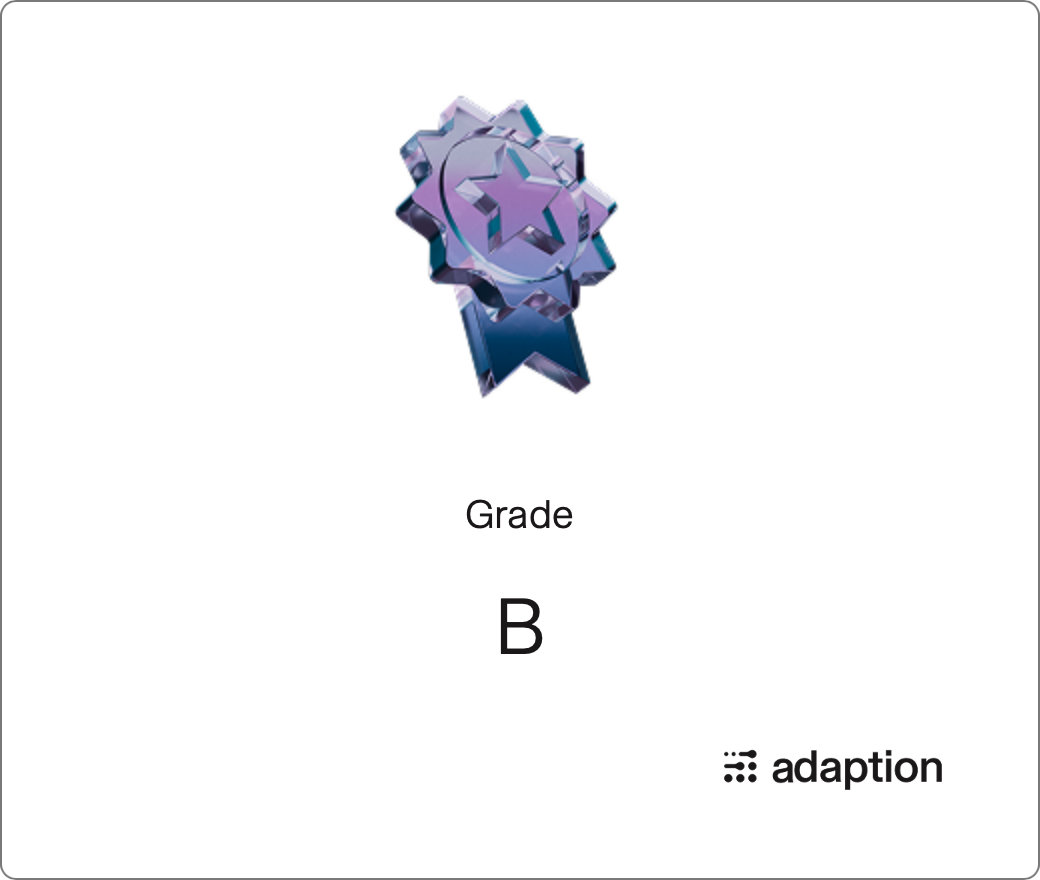
The final quality is B, with a relative quality improvement of -1.2%.
Domain
- Science (90%)
- Math (4%)
- History (4%)
Language
- English (74%)
- Hindi (26%)
Tone
- Explanatory (30%)
- Informative (24%)
- Analytical (24%)
Evaluation Results
Quality Gains:

Grade Improvement:
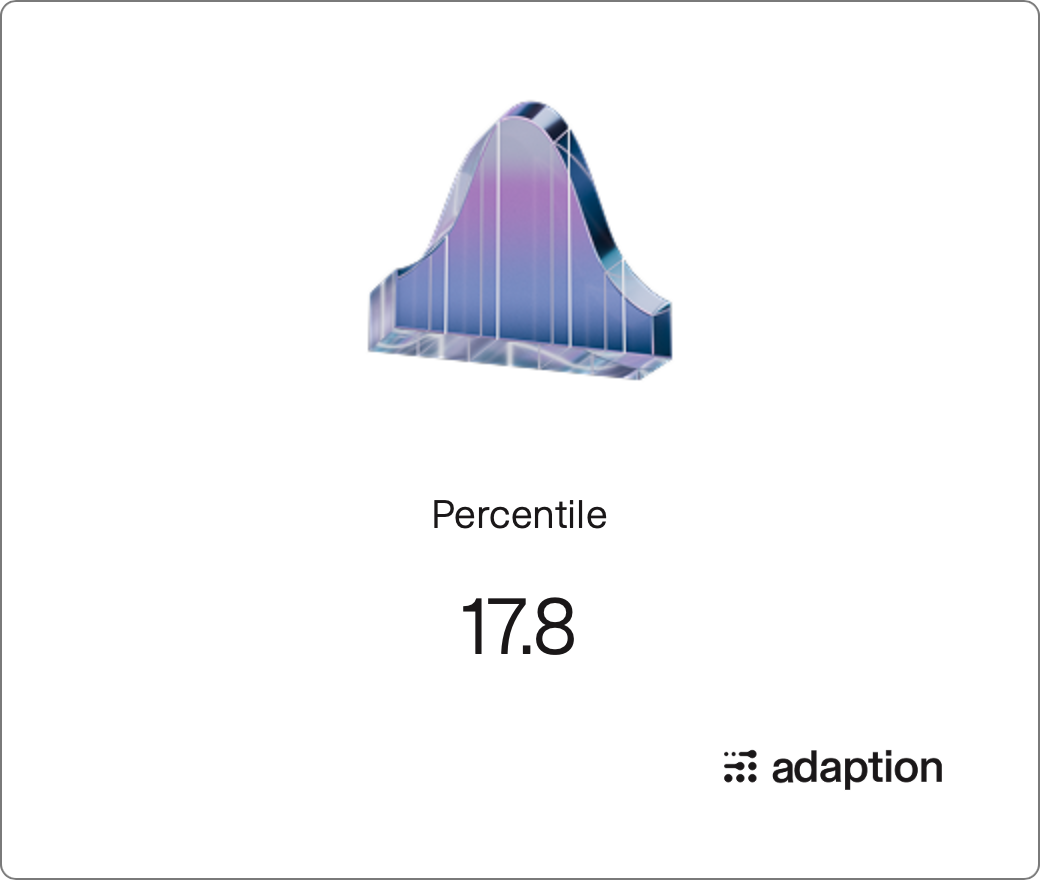
Percentile Chart:
- Downloads last month
- 46