


license: apache-2.0






News | Quick Start | Benchmark Usage | Citation
EditScore is a series of state-of-the-art open-source reward models (7B–72B) designed to evaluate and enhance instruction-guided image editing.
✨ Highlights
- State-of-the-Art Performance: Effectively matches the performance of leading proprietary VLMs. With a self-ensembling strategy, our largest model surpasses even GPT-5 on our comprehensive benchmark, EditReward-Bench.
- A Reliable Evaluation Standard: We introduce EditReward-Bench, the first public benchmark specifically designed for evaluating reward models in image editing, featuring 13 subtasks, 11 state-of-the-art editing models (including proprietary models) and expert human annotations.
- Simple and Easy-to-Use: Get an accurate quality score for your image edits with just a few lines of code.
- Versatile Applications: Ready to use as a best-in-class reranker to improve editing outputs, or as a high-fidelity reward signal for stable and effective Reinforcement Learning (RL) fine-tuning.
🔥 News
- 2025-10-16: Training datasets EditScore-Reward-Data and EditScore-RL-Data are available.
- 2025-10-15: EditScore is now available on PyPI — install it easily with
pip install editscore. - 2025-10-15: Best-of-N inference scripts for OmniGen2, Flux-dev-Kontext, and Qwen-Image-Edit are now available! See this for details.
- 2025-09-30: We release OmniGen2-EditScore7B, unlocking online RL For Image Editing via high-fidelity EditScore. LoRA weights are available at Hugging Face and ModelScope.
- 2025-09-30: We are excited to release EditScore and EditReward-Bench! Model weights and the benchmark dataset are now publicly available. You can access them on Hugging Face: Models Collection and Benchmark Dataset, and on ModelScope: Models Collection and Benchmark Dataset.
📖 Introduction
While Reinforcement Learning (RL) holds immense potential for this domain, its progress has been severely hindered by the absence of a high-fidelity, efficient reward signal.
To overcome this barrier, we provide a systematic, two-part solution:
A Rigorous Evaluation Standard: We first introduce EditReward-Bench, a new public benchmark for the direct and reliable evaluation of reward models. It features 13 diverse subtasks and expert human annotations, establishing a gold standard for measuring reward signal quality.
A Powerful & Versatile Tool: Guided by our benchmark, we developed the EditScore model series. Through meticulous data curation and an effective self-ensembling strategy, EditScore sets a new state of the art for open-source reward models, even surpassing the accuracy of leading proprietary VLMs.
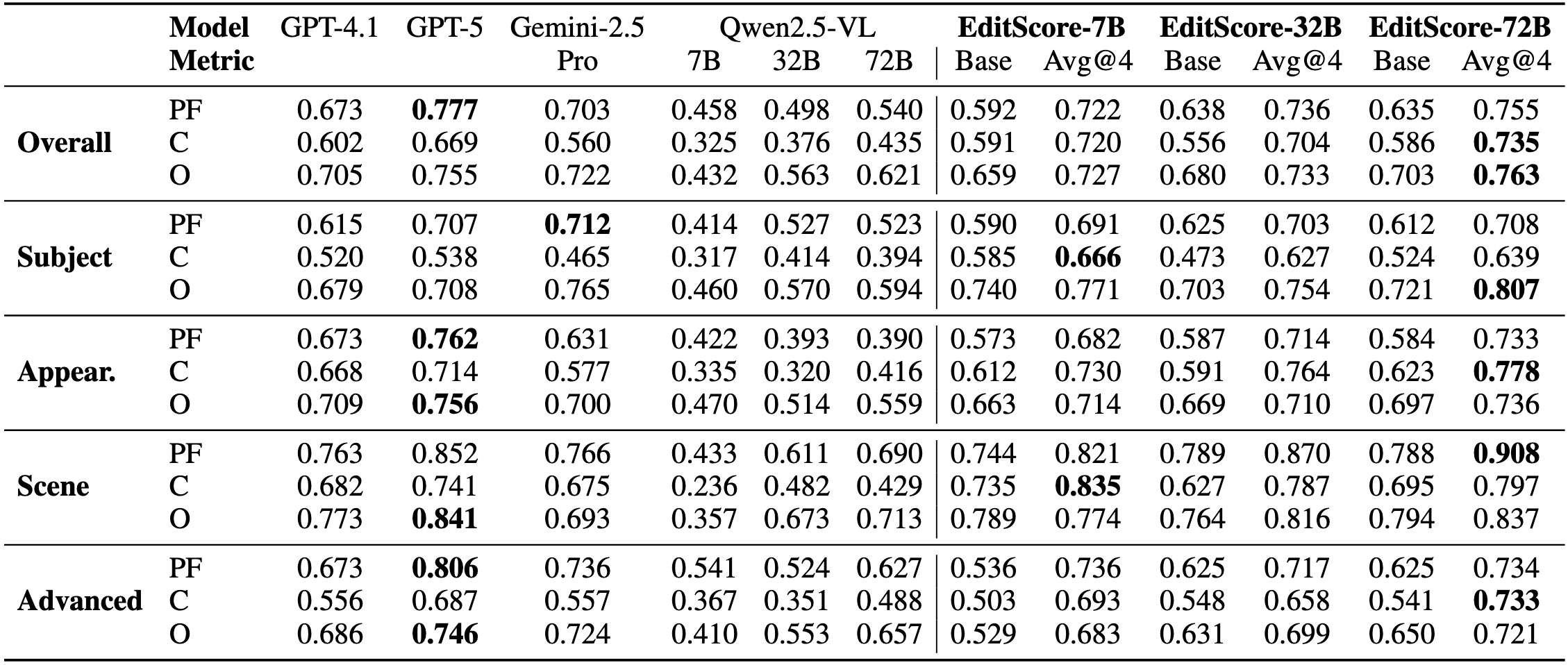
Benchmark results on EditReward-Bench.
We demonstrate the practical utility of EditScore through two key applications:
- As a State-of-the-Art Reranker: Use EditScore to perform Best-of-N selection and instantly improve the output quality of diverse editing models.
- As a High-Fidelity Reward for RL: Use EditScore as a robust reward signal to fine-tune models via RL, enabling stable training and unlocking significant performance gains where general-purpose VLMs fail.
This repository releases both the EditScore models and the EditReward-Bench dataset to facilitate future research in reward modeling, policy optimization, and AI-driven model improvement.
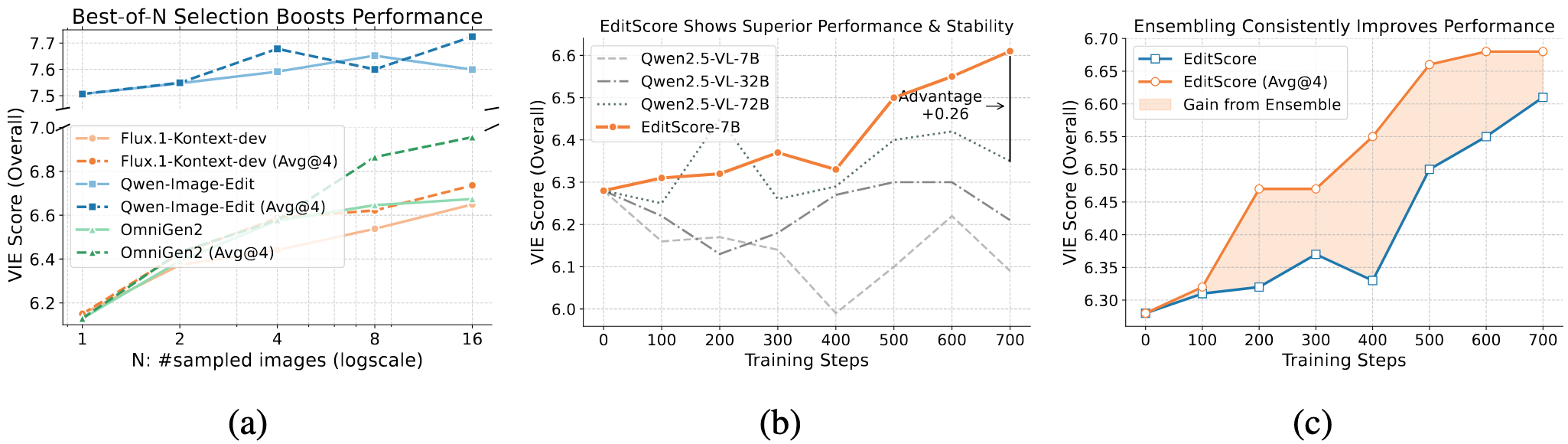
EditScore as a superior reward signal for image editing.
📌 TODO
We are actively working on improving EditScore and expanding its capabilities. Here's what's next:
- Release training data for reward model and online RL.
- Release RL training code applying EditScore to OmniGen2.
- Provide Best-of-N inference scripts for OmniGen2, Flux-dev-Kontext, and Qwen-Image-Edit.
🚀 Quick Start
🛠️ Environment Setup
We offer two ways to install EditScore. Choose the one that best fits your needs. Method 1: Install from PyPI (Recommended for Users): If you want to use EditScore as a library in your own project. Method 2: Install from Source (For Developers): If you plan to contribute to the code, modify it, or run the examples in this repository
Prerequisites: Installing PyTorch
Both installation methods require PyTorch to be installed first, as its version is dependent on your system's CUDA setup.
# (Optional) Create a clean Python environment
conda create -n editscore python=3.12
conda activate editscore

# Choose the command that matches your CUDA version.
# This example is for CUDA 12.6.
pip install torch==2.7.1 torchvision --extra-index-url https://download.pytorch.org/whl/cu126
🌏 For users in Mainland China
```bash # Install PyTorch from a domestic mirror pip install torch==2.7.1 torchvision --index-url https://mirror.sjtu.edu.cn/pytorch-wheels/cu126 ```Method 1: Install from PyPI (Recommended for Users)
pip install -U editscore
Method 2: Install from Source (For Developers)
This method gives you a local, editable version of the project.
- Clone the repository
git clone https://github.com/VectorSpaceLab/EditScore.git
cd EditScore
- Install EditScore in editable mode
pip install -e .
✅ (Recommended) Install Optional High-Performance Dependencies
For the best performance, especially during inference, we highly recommend installing vllm.
pip install vllm
🧪 Usage Example
Using EditScore is straightforward. The model will be automatically downloaded from the Hugging Face Hub on its first run.
from PIL import Image
from editscore import EditScore

# Load the EditScore model. It will be downloaded automatically.
# Replace with the specific model version you want to use.
model_path = "Qwen/Qwen2.5-VL-7B-Instruct"
lora_path = "EditScore/EditScore-7B"

scorer = EditScore(
    backbone="qwen25vl", # set to "qwen25vl_vllm" for faster inference
    model_name_or_path=model_path,
    enable_lora=True,
    lora_path=lora_path,
    score_range=25,
    num_pass=1, # Increase for better performance via self-ensembling
)

input_image = Image.open("example_images/input.png")
output_image = Image.open("example_images/output.png")
instruction = "Adjust the background to a glass wall."

result = scorer.evaluate([input_image, output_image], instruction)
print(f"Edit Score: {result['final_score']}")
# Expected output: A dictionary containing the final score and other details.
📊 Benchmark Your Image-Editing Reward Model
Install benchmark dependencies
To use example code for benchmark, run following
pip install -r requirements.txt
We provide an evaluation script to benchmark reward models on EditReward-Bench. To evaluate your own custom reward model, simply create a scorer class with a similar interface and update the script.
# This script will evaluate the default EditScore model on the benchmark
bash evaluate.sh

# Or speed up inference with VLLM
bash evaluate_vllm.sh
Apply EditScore to Image Editing
We offer two example use cases for your exploration:
- Best-of-N selection: Use EditScore to automatically pick the most preferred image among multiple candidates.
- Reinforcement fine-tuning: Use EditScore as a reward model to guide RL-based optimization.
For detailed instructions and examples, please refer to the documentation.
❤️ Citing Us
If you find this repository or our work useful, please consider giving a star ⭐ and citation 🦖, which would be greatly appreciated:
@article{luo2025editscore,
  title={EditScore: Unlocking Online RL for Image Editing via High-Fidelity Reward Modeling},
  author={Xin Luo and Jiahao Wang and Chenyuan Wu and Shitao Xiao and Xiyan Jiang and Defu Lian and Jiajun Zhang and Dong Liu and Zheng Liu},
  journal={arXiv preprint arXiv:2509.23909},
  year={2025}
}