


HiggsAudio-V2 Model Architecture

Our model is built on top of Llama-3.2-3B. To enhance the model’s ability to process audio tokens, we incorporate the "DualFFN" architecture as an audio adapter. DualFFN acts as an audio-specific expert, boosting the LLM's performance with minimal computational overhead. Our implementation preserves 91% of the original LLM’s training speed with the inclusion of DualFFN.
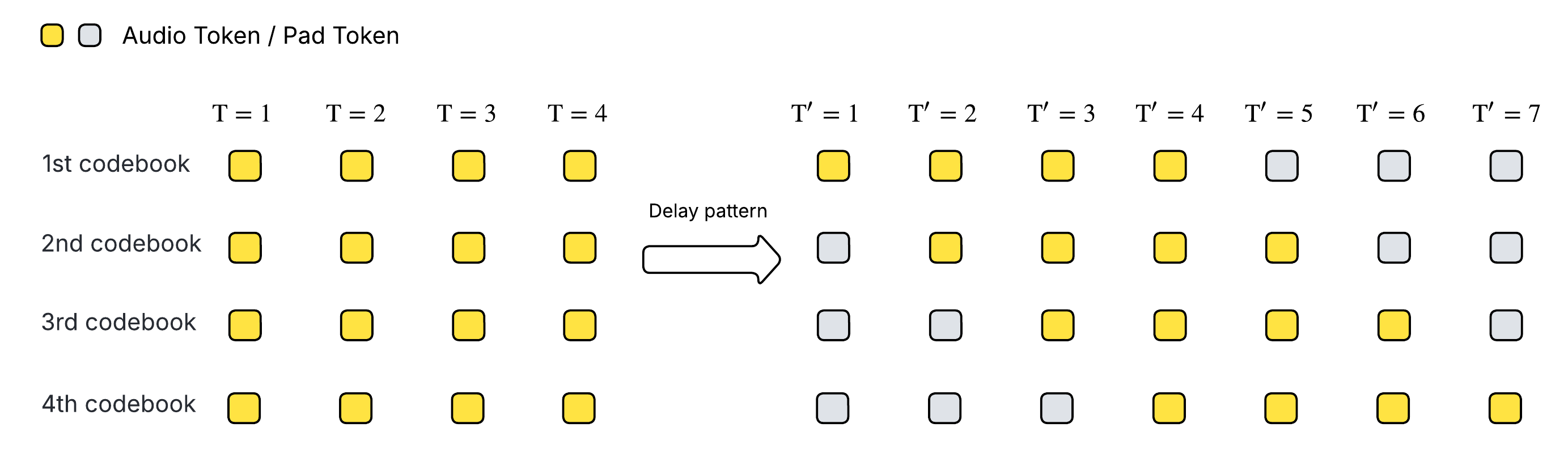
Since our audio tokenizer is based on Residual Vector-Quantization (RVQ) and contains multiple codebooks, we adopt the delay pattern to enable simultaneous code generation across codebooks while supporting streaming.
DualFFN Performance Ablation Study
To assess the effectiveness of DualFFN, we trained two smaller models based on LLaMA-3.1-1B: one incorporating DualFFN and one without. Both models were trained for 250K steps with a learning rate of 5e-4 on a subset of the AudioVerse dataset. We evaluated their performance on SeedTTS-Eval, with the results presented in the figures below. The model equipped with DualFFN consistently outperforms its counterpart in terms of word error rate (WER) and speaker similarity.
- SeedTTS-EN


- SeedTTS-ZH
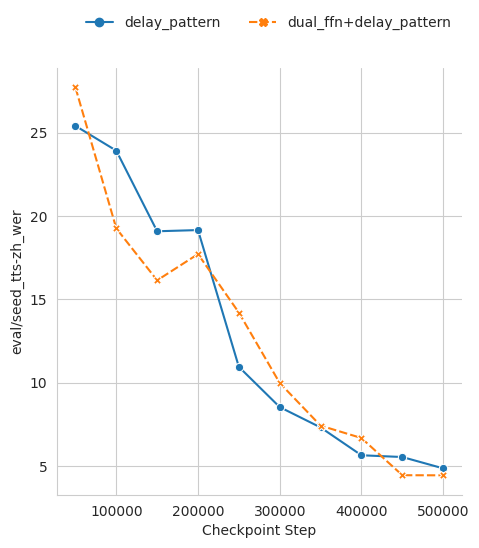

We may notice that the model with DualFFN consistently outperforms the model without DualFFN in terms of word-error-rate (WER) and speaker similarity.