Post
1588
🏆 BEHAVIOR Challenge 1st Place – Solution Summary
My team recently won 1st place in the BEHAVIOR Challenge at NeurIPS.
The competition focused on training a single policy to complete 50 long-horizon household tasks in simulation.
We built an end-to-end policy based on Pi0.5 with a bunch of custom modifications. Everything is open-sourced, and it should be useful for anyone exploring VLAs or adapting them to specific tasks.
Key Architecture Changes:
- Replaced language model with 50 trainable task embeddings (no text at all)
- Correlated noise for Flow Matching: ϵ ∼ N(0, 0.5I + 0.5Σ) using dataset action covariance
- Learnable mixed-layer attention: each action expert layer attends to a trainable mix of all VLM layers
- System 2 stage tracking: model predicts task stage, we smooth it with voting and feed it back as context
Training:
- Multi-sample Flow Matching: 15 FM samples per VLM pass to reduce gradient variance
- Delta action space + per-timestamp normalization
- FAST auxiliary loss and stage prediction loss
- Trained on 224×224 RGB + proprioception only
- We use 4 fine-tuned checkpoints, all derived from a multi-task model trained on all 50 tasks
Inference Optimizations:
- Soft inpainting: predict 30 actions, execute 26, use 4 as an input for the next chunk
- Correlation-aware guidance of inpainting to keep action chunks smooth
- 1.3× speedup via cubic spline compression
- General correction rule: reopen gripper after failed grasps
🔗 Code and Models:
- Code: https://github.com/IliaLarchenko/behavior-1k-solution
- Weights: IliaLarchenko/behavior_submission
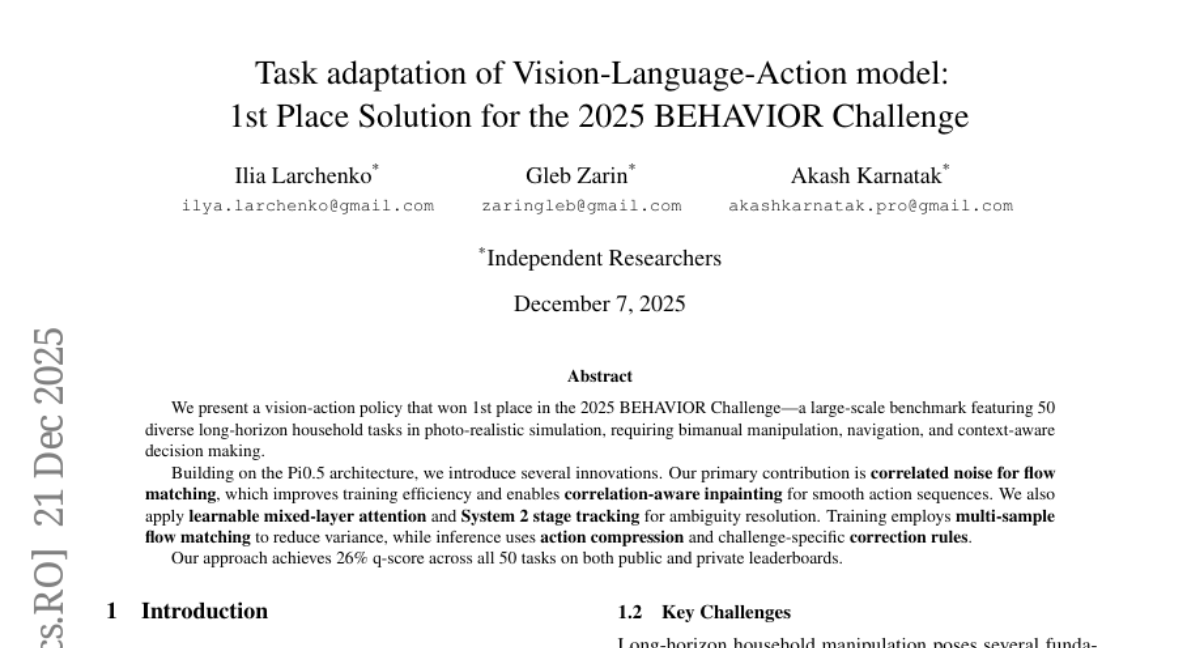
- Paper: Task adaptation of Vision-Language-Action model: 1st Place Solution for the 2025 BEHAVIOR Challenge (2512.06951)
My team recently won 1st place in the BEHAVIOR Challenge at NeurIPS.
The competition focused on training a single policy to complete 50 long-horizon household tasks in simulation.
We built an end-to-end policy based on Pi0.5 with a bunch of custom modifications. Everything is open-sourced, and it should be useful for anyone exploring VLAs or adapting them to specific tasks.
Key Architecture Changes:
- Replaced language model with 50 trainable task embeddings (no text at all)
- Correlated noise for Flow Matching: ϵ ∼ N(0, 0.5I + 0.5Σ) using dataset action covariance
- Learnable mixed-layer attention: each action expert layer attends to a trainable mix of all VLM layers
- System 2 stage tracking: model predicts task stage, we smooth it with voting and feed it back as context
Training:
- Multi-sample Flow Matching: 15 FM samples per VLM pass to reduce gradient variance
- Delta action space + per-timestamp normalization
- FAST auxiliary loss and stage prediction loss
- Trained on 224×224 RGB + proprioception only
- We use 4 fine-tuned checkpoints, all derived from a multi-task model trained on all 50 tasks
Inference Optimizations:
- Soft inpainting: predict 30 actions, execute 26, use 4 as an input for the next chunk
- Correlation-aware guidance of inpainting to keep action chunks smooth
- 1.3× speedup via cubic spline compression
- General correction rule: reopen gripper after failed grasps
🔗 Code and Models:
- Code: https://github.com/IliaLarchenko/behavior-1k-solution
- Weights: IliaLarchenko/behavior_submission
- Paper: Task adaptation of Vision-Language-Action model: 1st Place Solution for the 2025 BEHAVIOR Challenge (2512.06951)