I’ve found a code to train from scratch cpu a model but that isn’t the best i hope someone can upgrade it the code (the vae nedd to train minimum 20 epochs and you can up the dataset images to 833 for better images,the training of the unet(Vae reconstruction image,Unet génération image )is the most slower step):
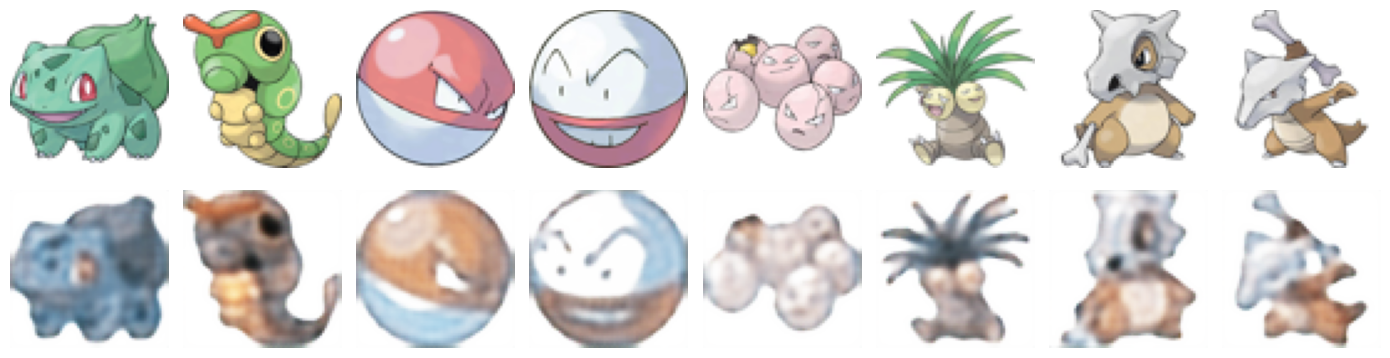
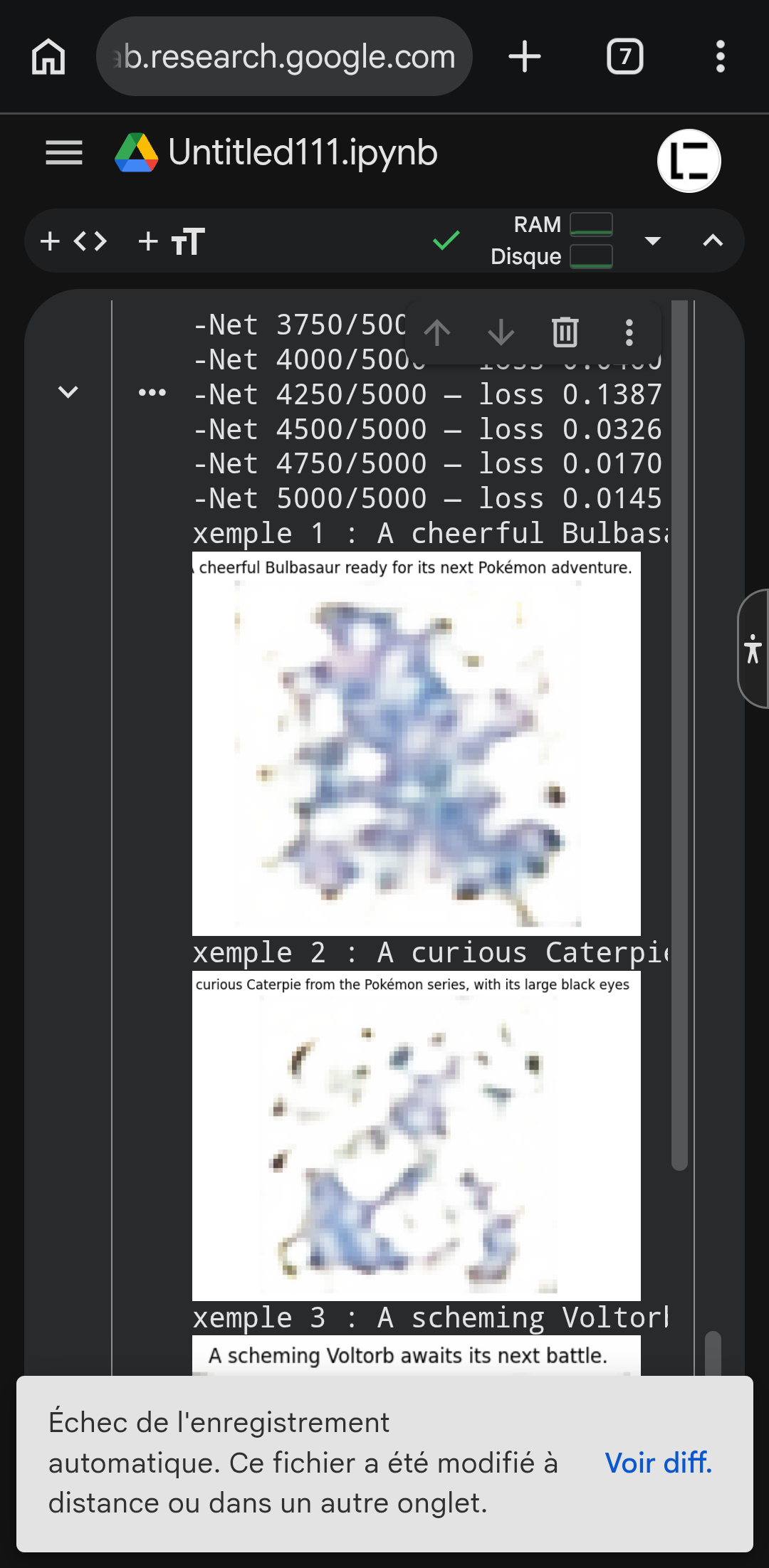
I think it’s can work :
```# Au besoin, décommentez :
# %pip -q install datasets pillow matplotlib
import re, math, random, torch
import torch.nn as nn
import torch.nn.functional as F
import matplotlib.pyplot as plt
from datasets import load_dataset
from PIL import Image
# Réglages
torch.set_num_threads(min(4, torch.get_num_threads()))
torch.manual_seed(42)
random.seed(42)
device = torch.device(“cpu”)
SIZE = 64
LIMIT = 500
BATCH = 4
VAE_EPOCHS = 20
DIFF_STEPS = 2000
T = 100
MAX_TOKENS = 24
LR = 1e-3
# Chargement des images et légendes
ds = load_dataset(“diffusers/pokemon-gpt4-captions”, split=“train”)
images, captions = [], []
for row in ds:
im = row.get("image")

caption = row.get("text") or row.get("caption") or row.get("prompt")

if im is None or not caption:

    continue

if not isinstance(im, Image.Image):

    im = Image.fromarray(im)

im = im.convert("RGB").resize((SIZE, SIZE))

arr = torch.tensor(bytearray(im.tobytes()), dtype=torch.uint8)

image = arr.reshape(SIZE, SIZE, 3).permute(2, 0, 1).float() / 127.5 - 1

images.append(image)

captions.append(str(caption))

if len(images) >= LIMIT:

    break
if not images:
raise ValueError("Aucune image/légende trouvée dans le dataset.")
images = torch.stack(images)
print(f"Images : {len(images)} — forme : {tuple(images.shape)}")
# Vocabulaire construit à partir des légendes
words = [re.findall(r"\w+", s.lower())[:MAX_TOKENS] for s in captions]
vocab = {“”: 0, “”: 1}
for sentence in words:
for word in sentence:

    if word not in vocab:

        vocab\[word\] = len(vocab)
tokens = torch.zeros(len(words), MAX_TOKENS, dtype=torch.long)
for i, sentence in enumerate(words):
ids = \[vocab.get(w, 1) for w in sentence\]

if ids:

    tokens\[i, :len(ids)\] = torch.tensor(ids)
# VAE : 64x64 → latent 16x16 → 64x64
class VAE(nn.Module):
def \__init_\_(self):

    super().\__init_\_()

    self.enc = nn.Sequential(

        nn.Conv2d(3, 32, 4, 2, 1), nn.SiLU(),

        nn.Conv2d(32, 64, 4, 2, 1), nn.SiLU(),

        nn.Conv2d(64, 128, 3, padding=1), nn.SiLU()

    )

    self.mu = nn.Conv2d(128, 4, 3, padding=1)

    self.logvar = nn.Conv2d(128, 4, 3, padding=1)

    self.dec = nn.Sequential(

        nn.Conv2d(4, 128, 3, padding=1), nn.SiLU(),

        nn.ConvTranspose2d(128, 64, 4, 2, 1), nn.SiLU(),

        nn.ConvTranspose2d(64, 32, 4, 2, 1), nn.SiLU(),

        nn.Conv2d(32, 3, 3, padding=1), nn.Tanh()

    )

def encode(self, x):

    h = self.enc(x)

    return self.mu(h), self.logvar(h).clamp(-10, 10)
vae = VAE().to(device)
opt_vae = torch.optim.AdamW(vae.parameters(), lr=2e-4)
# Entraînement VAE
for epoch in range(VAE_EPOCHS):
vae.train()

order = torch.randperm(len(images))

losses = \[\]

for start in range(0, len(images), BATCH):

    batch = images\[order\[start:start+BATCH\]\]

    mu, logvar = vae.encode(batch)

    recon = vae.dec(mu)  # reconstruction déterministe depuis mu

    recon_loss = F.l1_loss(recon, batch)

    kl = -0.5 \* (1 + logvar - mu.square() - logvar.exp()).mean()

    loss = recon_loss + 1e-4 \* kl

    opt_vae.zero_grad(set_to_none=True)

    loss.backward()

    opt_vae.step()

    losses.append(loss.item())

print(f"VAE {epoch+1}/{VAE_EPOCHS} — loss {sum(losses)/len(losses):.4f}")
# Vérification des reconstructions
vae.eval()
with torch.no_grad():
sample = images\[:8\]

mu, \_ = vae.encode(sample)

recon = vae.dec(mu)

assert recon.shape == sample.shape

assert torch.isfinite(recon).all()

print("Latent VAE :", tuple(mu.shape),

      "| MAE :", round(F.l1_loss(recon, sample).item(), 4))
fig, ax = plt.subplots(2, 8, figsize=(14, 4))
for i in range(8):
ax\[0, i\].imshow(((sample\[i\].permute(1,2,0)+1)/2).clamp(0,1))

ax\[1, i\].imshow(((recon\[i\].permute(1,2,0)+1)/2).clamp(0,1))

ax\[0, i\].axis("off")

ax\[1, i\].axis("off")
ax[0, 0].set_ylabel(“Original”)
ax[1, 0].set_ylabel(“VAE”)
plt.tight_layout()
plt.show()
# Encodage et normalisation des latents
vae.eval()
with torch.no_grad():
latents = torch.cat(\[

    vae.encode(images\[i:i+BATCH\])\[0\]

    for i in range(0, len(images), BATCH)

\])
latent_mean = latents.mean()
latent_std = latents.std().clamp(min=1e-5)
latents = (latents - latent_mean) / latent_std
assert latents.shape[1:] == (4, SIZE // 4, SIZE // 4)
assert torch.isfinite(latents).all()
print(“Latents :”, tuple(latents.shape), “écart-type :”, latent_std.item())
# Encodeur de texte appris de zéro
class TextModel(nn.Module):
def \__init_\_(self, vocab_size):

    super().\__init_\_()

    self.embedding = nn.Embedding(vocab_size, 128, padding_idx=0)

def forward(self, ids):

    emb = self.embedding(ids)

    mask = (ids != 0).float().unsqueeze(-1)

    return (emb \* mask).sum(1) / mask.sum(1).clamp(min=1)
text_model = TextModel(len(vocab)).to(device)
def norm_groups(ch):
return 8 if ch % 8 == 0 else 4
# Bloc résiduel qui injecte le conditionnement temps/texte
class ResBlock(nn.Module):
def \__init_\_(self, cin, cout):

    super().\__init_\_()

    self.norm1 = nn.GroupNorm(norm_groups(cin), cin)

    self.conv1 = nn.Conv2d(cin, cout, 3, padding=1)

    self.norm2 = nn.GroupNorm(norm_groups(cout), cout)

    self.conv2 = nn.Conv2d(cout, cout, 3, padding=1)

    self.emb = nn.Linear(128, 2 \* cout)

    self.skip = nn.Conv2d(cin, cout, 1) if cin != cout else nn.Identity()

def forward(self, x, emb):

    h = self.conv1(F.silu(self.norm1(x)))

    scale, shift = self.emb(F.silu(emb)).chunk(2, dim=1)

    h = self.norm2(h) \* (1 + scale\[:, :, None, None\]) + shift\[:, :, None, None\]

    h = self.conv2(F.silu(h))

    return (h + self.skip(x)) / math.sqrt(2)
# U-Net latent résiduel, créé de zéro
class UNet(nn.Module):
def \__init_\_(self):

    super().\__init_\_()

    self.time_mlp = nn.Sequential(

        nn.Linear(32, 128), nn.SiLU(), nn.Linear(128, 128)

    )

    self.text_mlp = nn.Sequential(

        nn.Linear(128, 128), nn.SiLU(), nn.Linear(128, 128)

    )

    self.input = nn.Conv2d(4, 64, 3, padding=1)

    self.enc1 = ResBlock(64, 64)

    self.down = nn.Conv2d(64, 128, 4, stride=2, padding=1)

    self.enc2 = ResBlock(128, 128)

    self.mid1 = ResBlock(128, 128)

    self.mid2 = ResBlock(128, 128)

    self.up = nn.ConvTranspose2d(128, 64, 4, stride=2, padding=1)

    self.dec = ResBlock(128, 64)

    self.out_norm = nn.GroupNorm(8, 64)

    self.out = nn.Conv2d(64, 4, 3, padding=1)

def forward(self, z, t, cond):

    f = torch.arange(16, device=z.device, dtype=z.dtype)

    phase = (t\[:, None\] \* T) \* torch.exp(-f \* math.log(10000) / 16)

    time_emb = torch.cat(\[phase.sin(), phase.cos()\], dim=1)

    emb = self.time_mlp(time_emb) + self.text_mlp(cond)

    h1 = self.enc1(self.input(z), emb)

    h2 = self.enc2(self.down(h1), emb)

    h = self.mid1(h2, emb)

    h = self.mid2(h, emb)

    h = self.up(h)

    h = self.dec(torch.cat(\[h, h1\], dim=1), emb)

    return self.out(F.silu(self.out_norm(h)))
unet = UNet().to(device)
train_params = list(unet.parameters()) + list(text_model.parameters())
optimizer = torch.optim.AdamW(train_params, lr=LR)
# Calendrier de diffusion
beta = torch.linspace(1e-4, 0.02, T, device=device)
alpha_bar = torch.cumprod(1 - beta, dim=0)
# Entraînement du U-Net
unet.train()
text_model.train()
for step in range(DIFF_STEPS):
ix = torch.randint(len(latents), (min(BATCH, len(latents)),))

clean = latents\[ix\]

ids = tokens\[ix\]

cond = text_model(ids)

t = torch.randint(T, (len(ix),))

noise = torch.randn_like(clean)

a = alpha_bar\[t\].view(-1, 1, 1, 1)

noisy = a.sqrt() \* clean + (1 - a).sqrt() \* noise

\# Masquage occasionnel du texte pour le classifier-free guidance

keep_text = (torch.rand(len(ix), 1) > 0.1).float()

cond = cond \* keep_text

pred = unet(noisy, t.float() / T, cond)

loss = F.mse_loss(pred, noise)

optimizer.zero_grad(set_to_none=True)

loss.backward()

torch.nn.utils.clip_grad_norm\_(train_params, 1.0)

optimizer.step()

if (step + 1) % 250 == 0:

    print(f"Diffusion {step+1}/{DIFF_STEPS} — loss {loss.item():.4f}")
# Génération DDIM
@torch.no_grad()
def generate(prompt, steps=50, guidance=1.5, seed=123):
unet.eval()

text_model.eval()

ws = re.findall(r"\\w+", prompt.lower())\[:MAX_TOKENS\]

ids = torch.zeros(1, MAX_TOKENS, dtype=torch.long)

if ws:

    ids\[0, :len(ws)\] = torch.tensor(\[vocab.get(w, 1) for w in ws\])

cond = text_model(ids)

null_cond = torch.zeros_like(cond)

gen = torch.Generator(device=device).manual_seed(seed)

z = torch.randn(1, 4, SIZE // 4, SIZE // 4, generator=gen, device=device)

schedule = torch.linspace(T - 1, 0, steps).long().tolist()

for j, i in enumerate(schedule):

    ti = torch.full((1,), i / T, device=device)

    eps0 = unet(z, ti, null_cond)

    eps1 = unet(z, ti, cond)

    eps = eps0 + guidance \* (eps1 - eps0)

    ab = alpha_bar\[i\]

    x0 = (z - (1 - ab).sqrt() \* eps) / ab.sqrt()

    if j + 1 < len(schedule):

        nxt = schedule\[j + 1\]

        z = alpha_bar\[nxt\].sqrt() \* x0 + (1 - alpha_bar\[nxt\]).sqrt() \* eps

    else:

        z = x0

z = z \* latent_std + latent_mean

result = vae.dec(z).clamp(-1, 1)

result = ((result\[0\] + 1) \* 127.5).byte().permute(1, 2, 0).cpu().numpy()

plt.figure(figsize=(5, 5))

plt.imshow(result)

plt.axis("off")

plt.title(prompt\[:70\])

plt.show()

return result
prompt = captions[0]
print(“Prompt de test :”, prompt)
generate(prompt)```